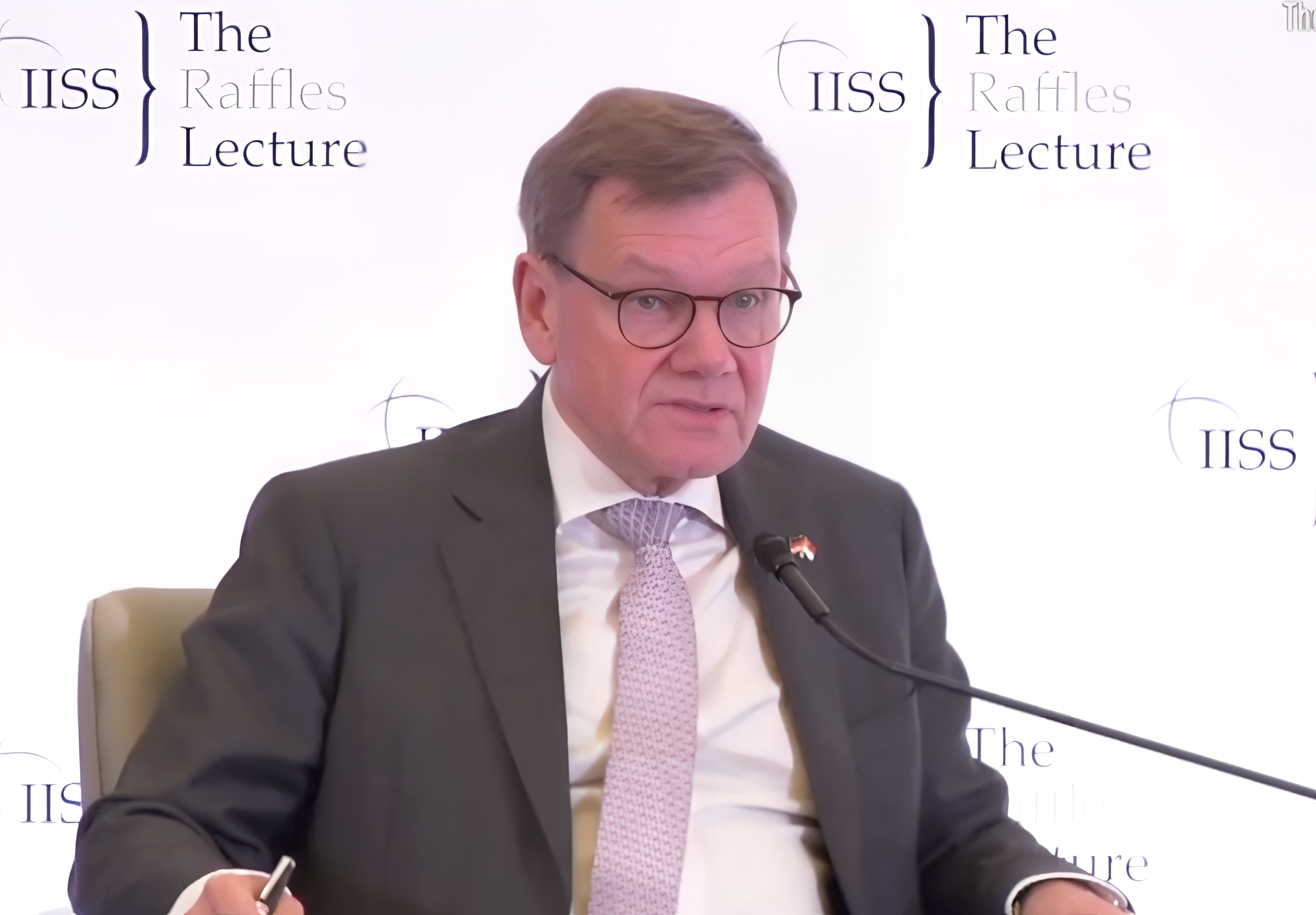
Germany’s Foreign Minister said on Monday during his visit to Singapore that the Chinese Communist Party (CCP) is a threat to the international rules-based order and that it would be a mistake to align closely with Beijing.
“China is still the same body and the Chinese system is still the same and the goals are the same and the threats for us for the international rules-based order and for our economy are still the same,” Germany’s Foreign Minister Johann Wadephul said at a lecture hosted by the International Institute for Strategic Studies (IISS).
“Then running with open arms to President Xi and saying all the problems vanished in this very moment and we are only heading to become your big partner. This would be the wrong answer, I would say,” he added.
Wadephul said that despite disagreements with Washington over tariffs and Greenland, the U.S. remains the most important ally of Germany and Europe.
“I would reiterate that still the United States is the most important partner to Europe and to Germany. Still our security for Europe depends on the United States.”
This trip marks Wadephul’s first visit to Singapore since taking office.
He has been pushing for the European Union (EU) to expand free trade agreements with Asia-Pacific partners.
During his trip to Singapore, Wadephul met with the Minister of Foreign Affairs Dr Vivian Balakrishnan where they affirmed closer cooperation between Germany and The Association of Southeast Asian Nations (ASEAN).
“The Ministers looked forward to deeper engagement between ASEAN and Germany, and between ASEAN and the EU,” according to a statement released by Singapore’s foreign affairs ministry.
“The Ministers also discussed international and regional developments, and reaffirmed their shared commitment to uphold and strengthen international law, the rules-based international order, and the multilateral trading system,” the statement added.
Both countries launched the Singapore-Germany Year of Innovation (YOI) to “further enhance cooperation between both countries in areas including AI, future technologies, clean technologies, defence technologies, business and start-up cooperation.”
After his Singapore trip, Wadephul will travel to New Zealand and Australia.
Wadephul’s Message to China
During his visit to China last December, Wadephul urged the CCP to ease export restrictions on rare earths and semiconductors and use its influence with Russia to help end the war in Ukraine.
The CCP started tightening rare-earth exports globally last year, widely seen by experts as leverage in trade negotiations with the U.S.
It added export controls on seven medium and heavy rare earth elements and related materials, requiring licences for exports as part of broader export-control policy moves amid rising trade tensions with the U.S. and other economies. These controls targeted materials used in industries such as defence, electronics, and electronic vehicle (EV) motors.
The CCP also significantly tightened export control by including a wider range of materials and restricting the export of technologies used in mining, processing, recycling and magnet production. The export controls include extra‑territorial provisions for some uses and tighter approval rules for exports to defence and semiconductor users.
Although Beijing suspended several of the export control announcements it had issued last October until November this year following high-level negotiations between the U.S. and CCP officials, core controls on certain rare earths remain in force.
The CCP’s moves have had real effects on global high-tech supply chains, affecting electronics, defence-related components, and semiconductor materials. The moves prompted other countries like India and Japan to diversify supply sources away from Chinese rare earth dependency.
Regarding the Russia-Ukraine war, concerns have been raised about the CCP’s support for Russia.
Just weeks before Russia’s invasion of Ukraine on Feb. 24, 2022, the CCP and Moscow had signed a “no limits” partnership on Feb. 4 during the Beijing summit.

In July last year, EU’s top diplomat Kajas Kallas met with Chinese Foreign Minister Wang Yi in Brussels, and made an appeal for the CCP to “immediately cease all material support that sustains Russia’s military industrial complex.”
Yi told Kallas that “Beijing did not want to see a Russian loss in Ukraine because it feared the United States would then shift its whole focus to Beijing, according to several people familiar with the exchange,” based on a report by the SCMP.
The CCP has denied that it is providing lethal weapons to either Russia or Ukraine.
Despite its denial, China’s economic and trade relationship with Russia has grown during the war including the export of technology and military supplies.
“In October, China deepened its support for Russia’s war effort through intelligence sharing, expanded drone supplies, and closer military cooperation, while strengthening diplomatic and economic ties with Russia,” according to a report last October by the Council on Foreign Relations.
The PBS News reported in April 2024 that Chinese equipment and components are ending up in Russian military systems.
“China has surged sales to Russia of machine tools, microelectronics and other technology that Moscow in turn is using to produce missiles, tanks, aircraft and other weaponry for use in its war against Ukraine, according to a U.S. assessment.”