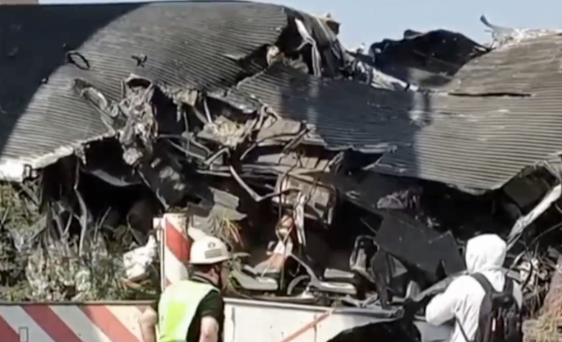
At least 32 people in Thailand were killed after a construction crane fell onto a passenger train in a project which is part of Beijing’s Belt and Road initiative (BRI).
66 were reportedly injured in the train disaster with 195 people on board.
The train was travelling from Thailand’s capital Bangkok .
The accident took place at the Sikhio district of Nakhon Ratchasima province, 230km north-east of Bangkok, on a northeast-bound train from the capital.
“I heard the noises, screeching and then bam bam, bam all the way over there,” an eyewitness Samai Teechantuek said. “When the dust settled, I saw the top of the train carriage.”
The search for more bodies and possible survivors is ongoing.
The construction crane was above the existing rail line. It was working on a high speed rail project that aims to connect Bangkok with China via Laos, a key part of Chinese leader Xi Jinping’s BRI, a global infrastructure to facilitate trade.
Construction began in 2017, but the segment within Thailand would not be completed until 2030.
China suggested that only the Thai company, Italian-Thai Development (ITD) is involved.
Chinese Foreign Ministry spokesperson Mao Ning on Wednesday expressed condolences over the casualties caused by the crane’s collapse, adding that “the relevant construction section is undertaken by a Thai enterprise, and the cause of the incident is still under investigation,” according to Chinese-state media the Global Times.
However, China’s state-run media China Daily in 2020 announced that two Chinese contractors have won contracts for the construction of the China-Thailand high-speed railway, including provision of expertise and supervision.
“The group’s two contractors–China Railway 11 Bureau Group Co Ltd and China Railway 23 Bureau Group Co Ltd–will build construction projects spanning 39.79 kilometers, including railway beds, bridges and railway stations for the first phase of the 250-km-long line linking the Thai capital Bangkok and the northeastern province of Nakhon Ratchasima.”
Both Chinese companies are owned by the Chinese state and are subsidiaries of China state-owned enterprise China Railway Construction Corporation Limited (CRCC).
China Daily added, “Under the agreement, China will provide expertise and supervision, while Thailand will provide equipment and materials. At the request of Thailand, China will also use a number of Thai engineers and architects to help transfer expertise in maintenance, operation and management of the high-speed railroad.”
Thailand’s Prime Minister Anutin Charnvirakul visited the disaster site, vowing to investigate the cause and compensate the victims.
“We have always been concerned about safety, but I think we have to investigate whether they have done this in accordance with the design and methods of construction or not.”
Anutin also said, “No matter what, it has already happened. So we need to make sure that we take care of every issue intensively.”
“Each contract has its own working conditions and established safety supervision measures,” Anan Phonimdaeng, Acting Governor of State Railway of Thailand said. “The authorities will review whether any parties neglected or failed to carry out their assigned duties.”
“If such negligence is found, legal action will be taken against those involved,” he added.
ITD expressed regret for the accident and said it would provide compensation for families of victims.
ITD, Chinese Partner Indicted for Collapse of 30-Storey Building
In a separate case, a joint venture company between a China-state-owned company and ITD were indicted in August last year following the collapse of a 30-storey building in Bangkok, according to a report from AP.
“Italian-Thai Development’s president, Premchai Karnasuta, and China Railway No. 10’s local director, Zhang Chuanling, were also indicted along with others, including designers, engineers and several other companies.”
The report added, “Those indicted include the lead contractors for the project: Italian-Thai Development Co. and its Chinese joint venture partner for the project, the China Railway No. 10 company.”
The charges in the various indictments include professional negligence in design, supervision, or construction practices that failed to comply with engineering standards, according to a statement from the Office of the Attorney General.
China Railway No. 10 is a subsidiary of China Railway Group Limited (CREC), a Chinese state-owned enterprise.
Both indicted companies had entered into a joint venture for the construction of the building as Thai law stipulates that foreign companies are allowed to own a maximum of 49% of the shares in Thai companies.
The building, a 30-storey Thailand Audit Office tower in Bangkok, was the only high-rise building in the capital to collapse from a 7.7 magnitude earthquake in neighbouring Myanmar, about 1,200 km away from the capital.
The earthquake killed at least 96 people in Bangkok, mostly at the collapsed site.
The structure of the building had been completed by the Chinese company.
Archived photos show the announcement of the building’s topout, a builders’ rite traditionally held when the last beam is placed at the top of a structure during its construction which has since come to mean the completion of a building structure.
A Chinese banner read, “Warm congratulations on the successful topout of the main structure of the Thailand Audit Office project undertaken by China Railway 10th Bureau.”