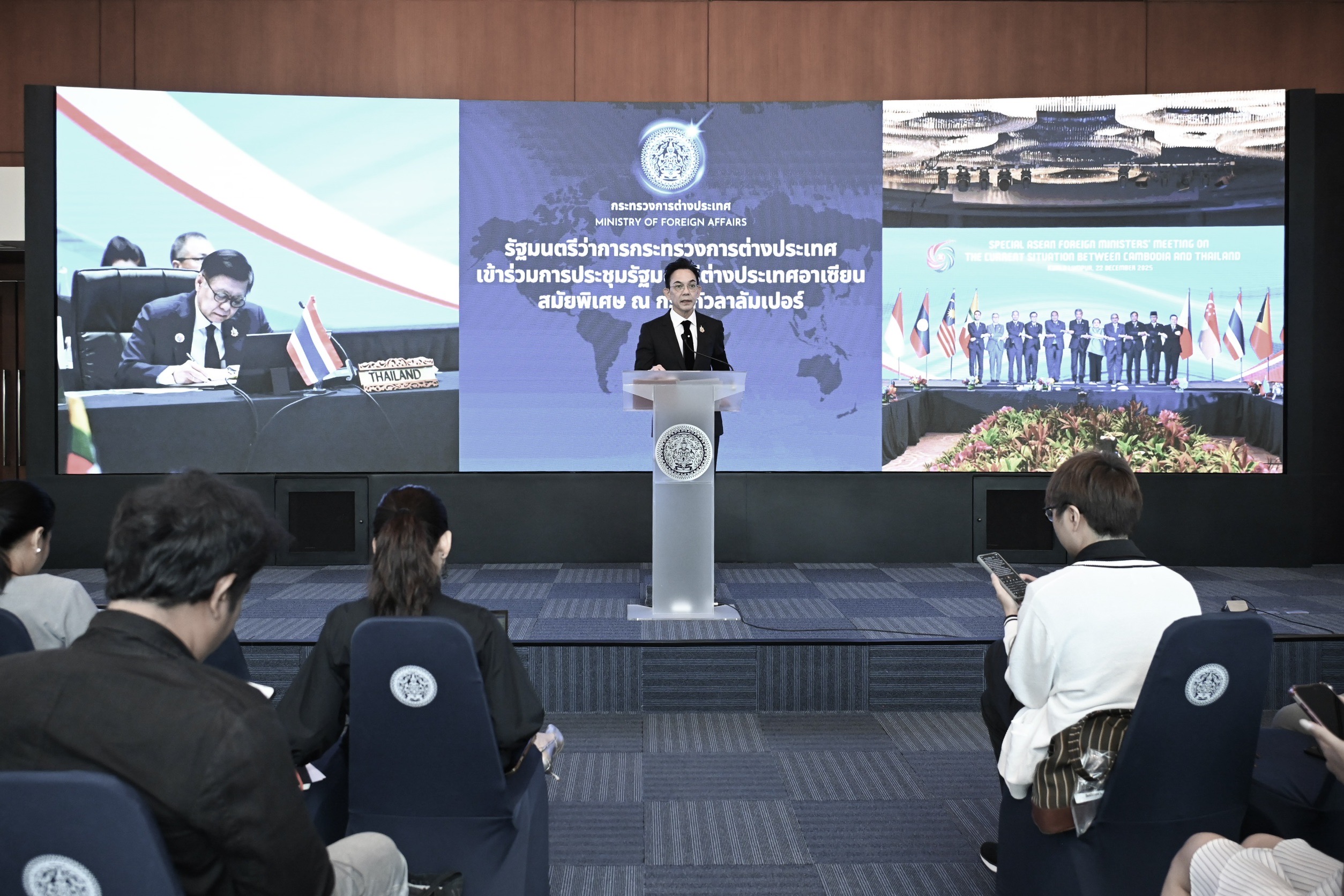
Thailand set out three key conditions necessary for the de-escalation of tensions at the Thai-Cambodian border following Thai Foreign Affairs Minister H.E. Mr. Sihasak Phuangketkeow’s Special ASEAN Foreign Ministers’ Meeting chaired by Malaysia.
A statement released by Thai Ministry of Foreign Affairs on Dec. 23 following a press briefing by spokesperson Nikorndej Balankura stated the three conditions, “(1) Cambodia must be the party to declare a ceasefire first; (2) the ceasefire by Cambodia must be genuine and sustained, with verification by the military based on actual conditions on the ground; and (3) Cambodia must demonstrate sincerity in cooperating with Thailand on humanitarian demining.”
“It must be observed that Cambodia has spoken of the ceasefire with all parties, yet has never engaged Thailand on this matter. This raised the question of whether Cambodia is genuinely serious and sincere about the ceasefire,” the statement added.
The statement reiterated that “a ceasefire cannot result from a unilateral declaration”.
Thailand continues to desire peace and sustainable peace must include the security and safety of the Thai people.
The statement also said Thailand’s past efforts of supporting Cambodia’s economic and rehabilitation shows it has never had any desire to be in any conflict with Cambodia.
“Since the period of Cambodia’s civil war, Thailand has supported efforts to restore peace within Cambodia, including by opening its border to provide shelter for those displaced by the conflict. Following the restoration of peace, Thailand has continued to support Cambodia’s economic and social rehabilitation through assistance in the construction of schools, hospitals, roads, and various public utilities.”
The statement also said that while Thailand has sought to resolve the conflict that broke out in July after Thai soldiers were injured in landmine blasts along the border, “Cambodia has attempted to internationalize the matter instead of working together to resolve the issue bilaterally,” adding that “there have also been efforts to undermine Thailand’s stability through actions by Cambodian leaders.”
The statement noted that Cambodia has violated the agreements for peace between the two countries.
“Cambodia has violated its obligations under these bilateral agreements and international law, particularly international humanitarian law, on numerous occasions. The repeated breaches of the Joint Declaration, especially the landmine incidents, cannot be ignored.”
It cited that a Thai marine became the eighth casualty to lose a leg on Dec. 21 as a result of newly planted landmines by Cambodia.
The statement reported that Thailand and Cambodia agreed at the meeting, as proposed by Thailand, that a ceasefire can only be achieved through joint discussions.
“It must come with the political will of both sides and be based on an assessment of the situation on the ground and detailed discussions by the military. This is to ensure that discussions leading to a sustainable ceasefire reflect the realities on the ground.”
The militaries of both sides will start to hold discussions on the resumption of the ceasefire and cessation of hostilities, and both sides agreed to convene the General Border Committee (GBC) on Dec. 24.
Thailand proposed to host the GBC meeting at a Thai border province.
‘This GBC meeting will enable the militaries of both sides to discuss implementation, related steps and verification of the ceasefire by the ASEAN Observer Team (AOT) in detail. The militaries of both sides will continue to coordinate on the arrangement of this meeting.”
“Thailand hopes to see Cambodia’s sincerity reflected in concrete actions in pursuit of genuine and lasting peace, not merely peace on paper,” the statement said.