
A report by a US think tank suggests that installations of facilities by Beijing in the Yellow Sea resemble the “creeping sovereignty” grey zone tactics that are employed for the Chinese militarisation of the South and East China Seas.
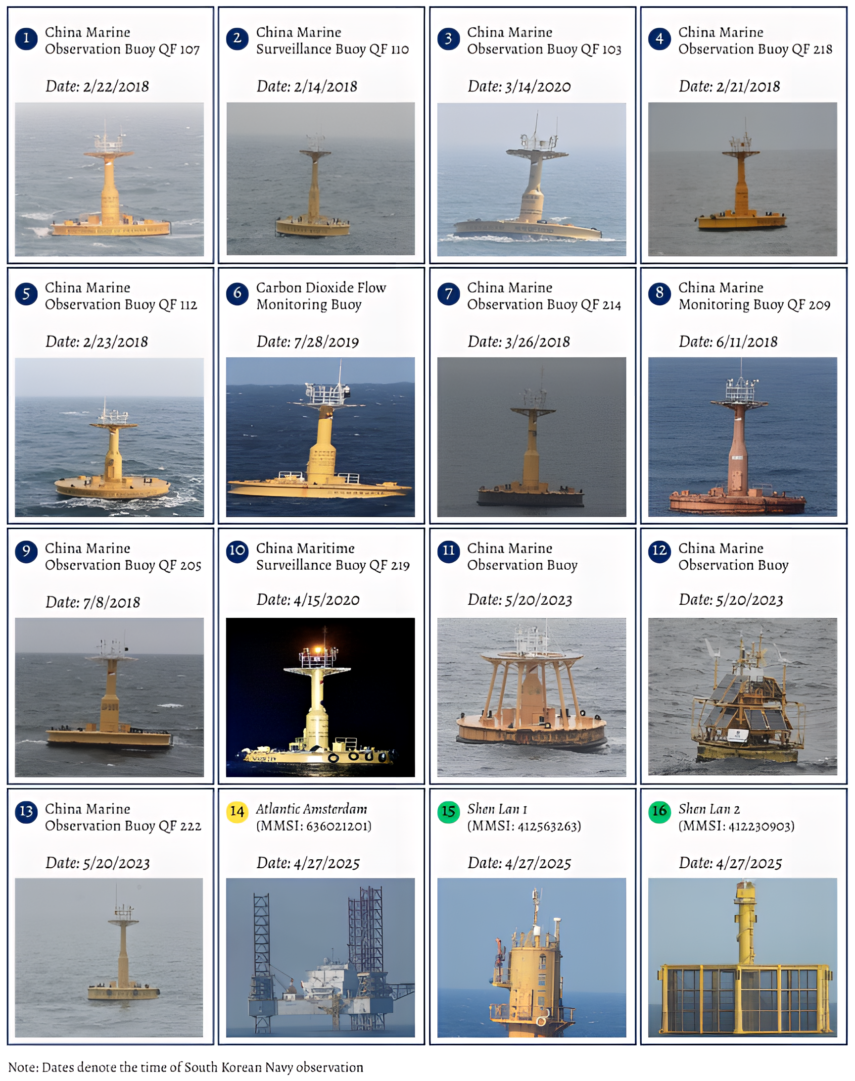
The report released by CSIS on Dec. 9 revealed that 16 structures installed by Beijing in the Yellow Sea (West Sea) without prior consultation with South Korea violated the 2001 Korea-China Fisheries Agreement signed between South Korea and China. The agreement is for the purpose of establishing a jointly managed maritime area called the Provisional Measures Zone (PMZ) in the Yellow Sea.
“Since 2018, China has unilaterally deployed 13 buoys in and around the PMZ in the Yellow Sea,” CSIS revealed.
“China has also constructed two aquaculture cages ostensibly to breed fish, and an integrated management platform in the PMZ without prior consultation with South Korea.”
It stated that “China’s placement of the Shen Lan 1, Shen Lan 2 and the Atlantic Amsterdam in the PMZ is a violation of the Korea-China Fisheries Agreement, which prohibits building permanent installations within the PMZ.”
The report said China has repeatedly rejected South Korea’s requests to remove the structures but also declared a “no-sail” zone within the PMZ.
South Korea has been monitoring the developments but its vessels have been intercepted 27 times out of 135 times since 2020, including “multiple instances of standoffs between the South Korean research vessel Onnuri and the Chinese coast guard this year.”
CSIS said the structures are “civilian installations for potential dual use purposes.”
Shen Ming-shi, a researcher at the Institute for National Defense and Security Research in Taiwan, told The Epoch Times that these buoys have multiple functions, including measuring water temperature and salinity. More importantly, “devices can be placed to listen to underwater sounds and detect the dynamics of submarines on the seabed, especially nuclear-powered submarines.”
Lin Chih-Hao, an assistant researcher at the Institute for National Defense and Security Research in Taiwan, explained the strategic intent of such installations by the Chinese Communist Party (CCP.)
The Yellow Sea is located at the mouth of the Bohai Sea in Shandong Province. “If a carrier strike group from a naval base in southern Shandong Province or a base in the Bohai Sea wants to sail south, maintaining influence or control in the Yellow Sea will ensure that naval forces can pass through the Yellow Sea smoothly,” Lin told the Epoch Times.
“In emergency situations or when necessary, it can monitor the situation at sea in the first instance and ensure that the South Korean Navy or Coast Guard will not take any adverse actions against the Chinese Navy in the Yellow Sea.”
Lin analyzed that the CCP’s “grey-zone tactics” often use buoys to extend sovereignty or to legitimize the actions of local governments in relevant areas. These actions may gradually erode the sovereignty or law enforcement legitimacy of other countries in the region.”
In summarizing the far-reaching impact of the CCP’s Yellow Sea strategy, Lin pointed out: “If the CCP expands its influence in the Yellow Sea, it means that North Korea will have a great opportunity to expand its smuggling routes and even the scope of its maritime activities through the CCP’s expansion of its maritime territory.”
He warned that this would not only affect operations and economic activity in the western waters of South Korea, but would also “compress the interests of other countries at sea” and “make Northeast Asia more tense.”