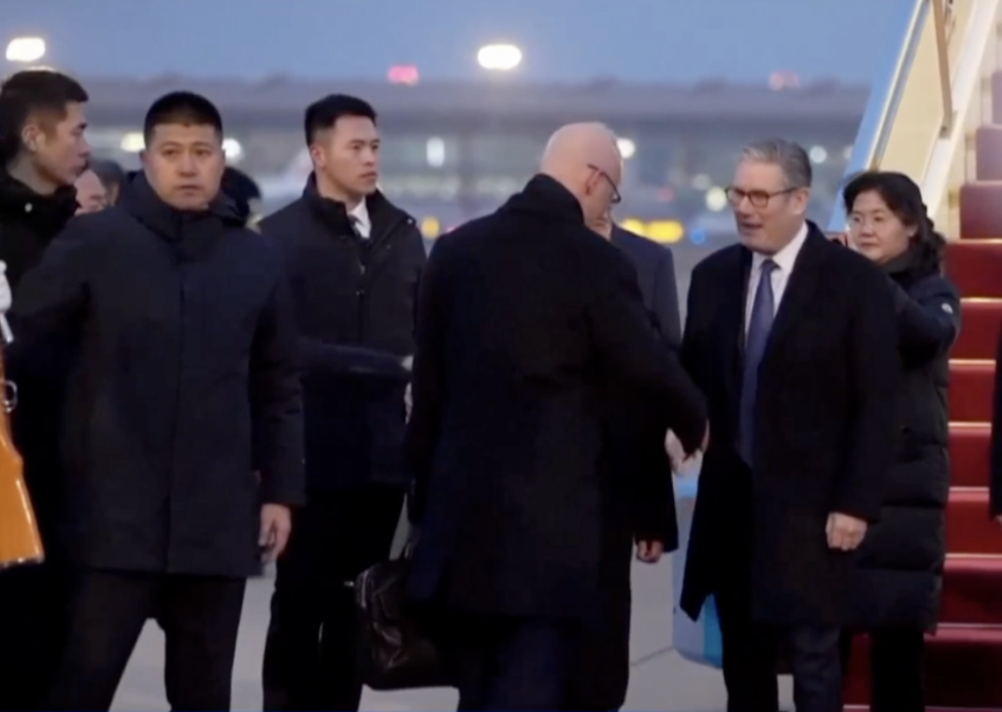
British Prime Minister Keir Starmer arrived in Beijing on Wednesday (Jan. 28) for a three-day state visit, amid calls for the prime minister to secure Jimmy Lai’s release and raise concerns on China’s human rights abuses.
Traveling with a delegation of business leaders, Starmer is slated to visit Shanghai and meet with Chinese Communist Party (CCP) leader Xi Jinping.
“Of course, we will have to manage our differences, but that’s what you do with a mature, consistent, comprehensive, and strategic approach to China,” Starmer said. “We manage our differences, we take our opportunities, and we constantly think, how does this deliver for people back at home?”
He is the first U.K. prime minister to visit China since former prime minister Theresa May in 2018.
China is considered a major trading partner for the U.K. but that relationship soured in recent years due to concern about espionage, CCP’s support for Russia in its war with Ukraine, and its repression of pro-democracy activists in Hong Kong.
Aside from building ties with China, Starmer is coming under pressure to secure the release of British citizen Jimmy Lai, a former media tycoon and one of Hong Kong’s most prominent pro-democracy figures. Lai was arrested in 2020 following the imposition of the Hong Kong National Security Law (NSL) by the CCP and is facing a potential sentence of life in prison.
“It is outrageous that any British prime minister should go to Beijing whilst a British citizen is incarcerated, languishing along with many pro-democracy campaigners in jails in Hong Kong and in mainland China,” said David Alton, a former member of British parliament.
Shortly before Starmer’s visit to China, the U.K. government approved a new supersized Chinese embassy in central London. That was despite pressure from lawmakers over national security concerns and protests from pro-democracy dissidents and activists who are worried about transnational repression by the CCP on England soil.
Critics warned the embassy could be used as a CCP outpost to intimidate and spy on Chinese dissidents in exile.
“This site will accommodate hundreds more Chinese state employees. We know what that means,” said Chloe Cheung, a pro-democracy activist who has a bounty of HK$1 million or S$165,000 on her head.
“More interference, more influence operations, and more intimidation of people like me,” she added.
A recent report by The Telegraph says a Chinese spying operation has been hacking the phones of senior U.K. officials for years.
Ahead of Starmer’s visit, more than a dozen organizations issued a joint letter urging the Prime Minister to raise the issue of CCP’s forced organ harvesting, a crime committed against spiritual groups like Falun Gong practitioners and other religious groups.
The China Tribunal has found credible evidence of the CCP’s forced organ harvesting over a 12-month investigation, releasing a “final judgement” in 2019 that said, “Within the Chinese transplant system, waiting times are said to be extremely short by international standards and at times, transplants of vital organs (hearts, full livers) can be ‘booked’ in advance.”
“The alleged victims of forced organ harvesting are primarily people who follow the Buddha School meditation practice of Falun Gong, possibly along with Uyghur Muslims (a Turkic ethnic group currently being detained in vast numbers in the Xinjiang region) and some Tibetan Buddhists and House Church Christians.”
When asked whether he would raise human rights issues with Beijing, Starmer did not go into specifics, but said that he would “raise the issues that need to be raised.”