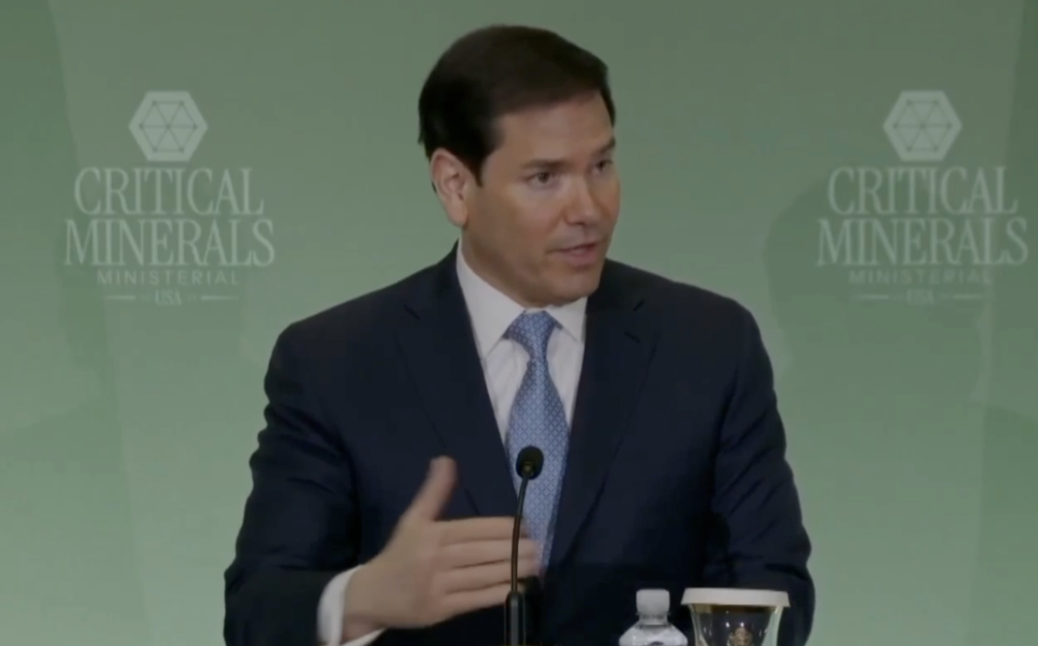
Over 55 countries are attending the critical minerals ministerial conference to be hosted by the U.S. in Washington DC this week, with the aim of reducing critical minerals dependency on China.
U.S. Secretary of State Marco Rubio said on Wednesday the goal is to prevent the kind of disruption that comes with a market monopoly, or that monopoly being used as leverage against other countries.
“That’s the key goal of a critical mineral supply, and today it’s heavily concentrated in the hands of one country,” Rubio said.
“And that lends itself to, at worst case scenario, being used as a tool of leverage in geopolitics, but it also lends itself to any sort of disruptions, like a pandemic or anything that could—political instability or anything that could happen,” he added.
U.S. Interior Secretary Doug Burgum said, “China has got a stranglehold.They can control anywhere between 85 to 100 percent of the top 20 critical minerals. This is a threat not just to the U.S., but to the whole world.”
National security concerns became more urgent for the Trump administration after the Chinese Communist Party (CCP) imposed export controls on rare earths last year, causing production delays and shutdowns for auto manufacturers in America and Europe.
“Every single one of us represented in this room has become dependent on arrangements we did not choose,” U.S. Vice President JD Vance said at the conference. “We all face the same vulnerability.”
“Access to the things that protect our people and sustain our way of life, everything from missile defence systems to applied chains that support these industries, sometimes can vanish in the blink of an eye without any control or influence from any of the countries in this room,” he added.
One of the objectives of the critical mineral initiative is to set a pricing mechanism that would counter the CCP’s predatory pricing practices that drove global rare earths miners and processors out of business years ago.
Half of the attendees have expressed interest in joining a preferential trade zone that will establish price floors for critical minerals.
Retired Capt. Brent Sadler at the Senior Research Fellow, Heritage Foundation, U.S. Navy told NTD news that CCP’s dominant role in the critical mineral supply chain is a deliberate strategy to drive dependency of critical minerals from the West.
“In the 90s that the Chinese Communist Party were, China was given kind of like the open door to corner this market, and it was by design,” Capt. Sadler said.
“At the same time, they would drive in a dependency of their potential adversaries in the Western world, notably the United States,” he added.