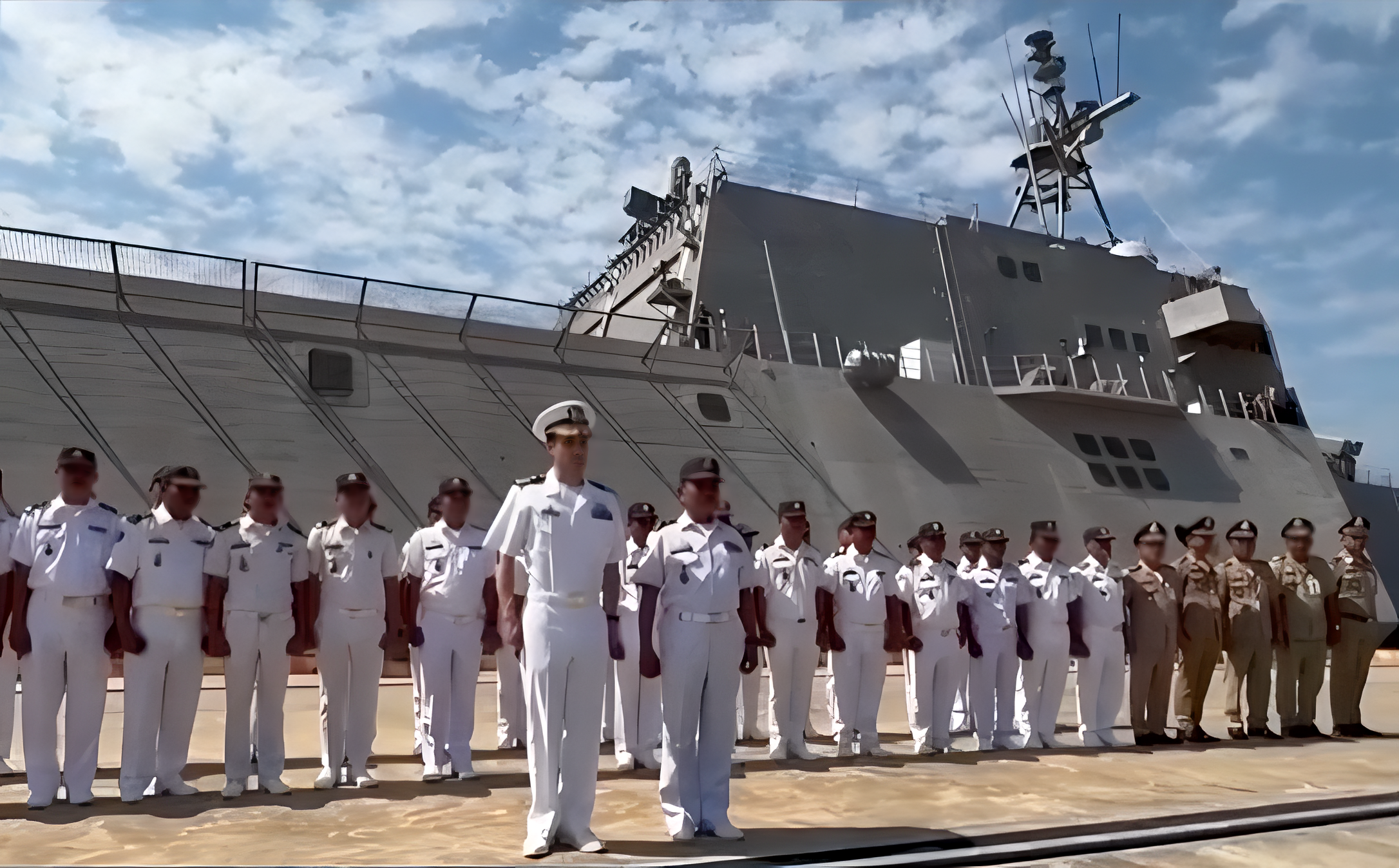
The head of US navy arrives at Cambodia’s Ream Naval Base amid concern China has been granted exclusive access to the base.
Admiral Samuel Papparo, the head of U.S. forces in the Indo-Pacific, hosted Gen. Tea Seiha, Cambodia’s Deputy Prime Minister and Minister of Defense aboard the USS Cincinnati on Monday (Jan. 26).

They discussed the U.S.-Cambodian defense relationship.
The two countries vowed to work shoulder to shoulder to uphold a free and open Indo-Pacific.
The USS Cincinnati has been docking at Cambodia’s Renewed Naval Base since Saturday.
This is one of the 37 U.S. warships that have visited the port over the past two decades.
But this marks the first time a U.S. Navy ship has docked at the port since Chinese-funded renovations were completed last year.
The renovation has fuelled concerns that China, Cambodia’s close ally and top provider of aid and investment, may have been granted exclusive access to the base.
Cambodia’s government has denied exclusive Chinese privileges.
“At this location, our government has worked very hard to build this port so that all foreign vessels that wish to dock in Cambodia can do so,” said In Sokhemra, Deputy Commander, Ream Naval Base.
Reports of a potential 30-year agreement between China and Cambodia that allow Chinese military use of the site have stoked fears that a global Chinese military base could be taking shape.
China currently operates a military base in Africa while the U.S. has 750 bases around the world, allowing Washington to project power around the globe.
Besides the port in Cambodia, China controls two additional ports, one in Pakistan and the other in Sri Lanka.
Meanwhile, it is building another deep sea port in Myanmar.
If Beijing manages to transform them into fully operational bases, it could project power across the Indian Ocean.
China Supports Cambodia’s Repression of Political Opponents
Cambodia is one of the closest allies of China and Beijing has defended the country’s repression of political opponents.
China supports Cambodia politically, economically, and strategically.
It is Cambodia’s largest foreign investor, largest trading partner and the biggest infrastructure financier.
China’s lending to the country surged in 2013 following the launch of the Belt and Road Initiative (BRI), a brainchild of Chinese leader Xi Jinping to develop global infrastructure with its trading partners.
By the late 2010s, China had become Cambodia’s largest creditor. Its outstanding loan with China is around $4 billion today. This is approximately one-third of Cambodia’s foreign debt.
The Cambodian government eliminated political opponents and arrested Kem Sokha, the leader of the main opposition party, the Cambodia National Rescue Party (CNRP). The Supreme Court dissolved the party in 2017 after Sokha’s arrest.
Many CNRP lawmakers fled overseas to avoid arrest.
Opposition politicians have been arrested, exiled, or banned from politics.
China defended Cambodia after the opposition party was dissolved.
“China supports the Cambodian side’s efforts to protect political stability and achieve economic development, and believes the Cambodian government can lead the people to deal with domestic and foreign challenges, and will smoothly hold elections next year,” China’s Foreign Ministry said, according to a report by Reuters.
While it cosies up to China, Cambodia has long and tense relations with the U.S.
The U.S. has called out the Cambodian government for political repression and human rights abuses.
The U.S. and E.U. have imposed sanctions on Cambodian officials but China opposes the sanctions because of its interests in Cambodia.