U.S. and Chinese fighter jets confronted one another as Japan’s Prime Minister sounded the alarm on increasing Chinese coercion.
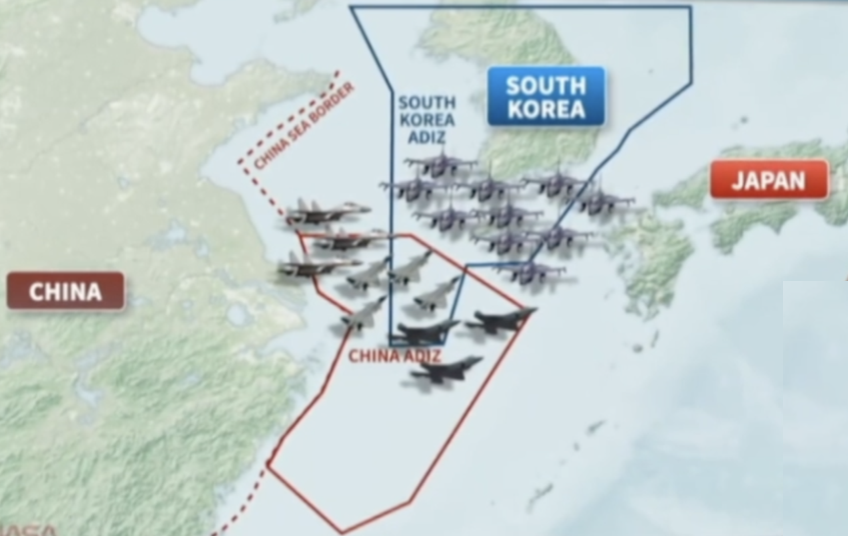
A rare confrontation occurred between U.S. and Chinese fighter jets briefly faced off near China on Wednesday.
About 10 U.S. jets left a South Korean base for drills between China and South Korea.
They did not enter China’s air defence identification zone (ADIZ), but Beijing scrambled planes as they approached.
ADIZ is not part of a country’s territory, but planes must identify themselves when entering.
China state-media the Global Times ramped up the rhetoric on Friday.
It reported that “it is unusual for US Air Force forces stationed in South Korea to conduct independent training near China’s air defense identification zone (ADIZ).”
The Chinese media outlet also reported that it was told by a military expert Zhang Junshe that the U.S. is monitoring the development of the Chinese army and exerting pressure against China.
“US military operations in the Yellow Sea usually serve two purposes: first, to conduct close-in reconnaissance in an attempt to monitor and grasp China’s maritime, aerial and land military developments; second, to exert strategic pressure and maintain a military deterrence posture against China by approaching China’s territorial seas and airspace,” Zhang said.
According to the Stars and Stripes, the U.S. and South Korea carried out “two large-scale military exercises each year” on land, air and sea throughout South Korea, adding that “both exercises are roughly two weeks long and contain dozens of separate drills.”
‘Freedom Shield’ is typically conducted in March while ‘Ulchi Freedom Shield’ is conducted in August.
Japan’s Prime Minister Sanae Takaichi warned of growing Chinese coercion in her first post-election speech as president in Parliament.
Beijing has been stepping up military pressure across the Indo-Pacific, fuelled by ongoing territorial disputes in the South China Sea and Chinese leader Xi Jinping’s instruction to the Chinese military to get ready by 2027 to attack Taiwan, according to U.S. intelligence.
Takaichi said Japan is facing its toughest security environment since World War II, pointing to Beijing’s expanding military activity in the East and South China Seas.
In December, Japan accused a Chinese fighter jet of locking its radar onto Japanese planes.
She also cited Beijing’s closer ties with Moscow and warned about Pyongyang’s nuclear missile programme.
Takaichi pledged to overhaul the country’s defence strategy and ease restrictions on military exports.
Currently, Japan exports non-lethal equipment like body armour but a policy panel from her party is proposing broader rules which would allow Japanese firms to sell a wider range of defence equipment overseas.
Takaichi also promised to strengthen critical supply chains.
Her tough stance follows months of tension with Beijing after her comments in parliament in November last year that Japan could use military force if China attacks Taiwan, a threat to the country’s interests.
Earlier this week, Takeichi said she hoped to deepen the U.S.-Japan relations in many ways when she meets with Trump next month.
“As for the upcoming Japan-U.S. summit, I would like to not only further enhance the trust with President Donald Trump, but also strengthen Japan-U.S. relations in various fields such as national security, economy and culture,” she said.
“Additionally, I am determined to enhance Japan-U.S. economic security, including critical minerals such as rare earths,” she added.
Takaichi won a landslide election last week, gaining more influence in parliament to advance her policies.