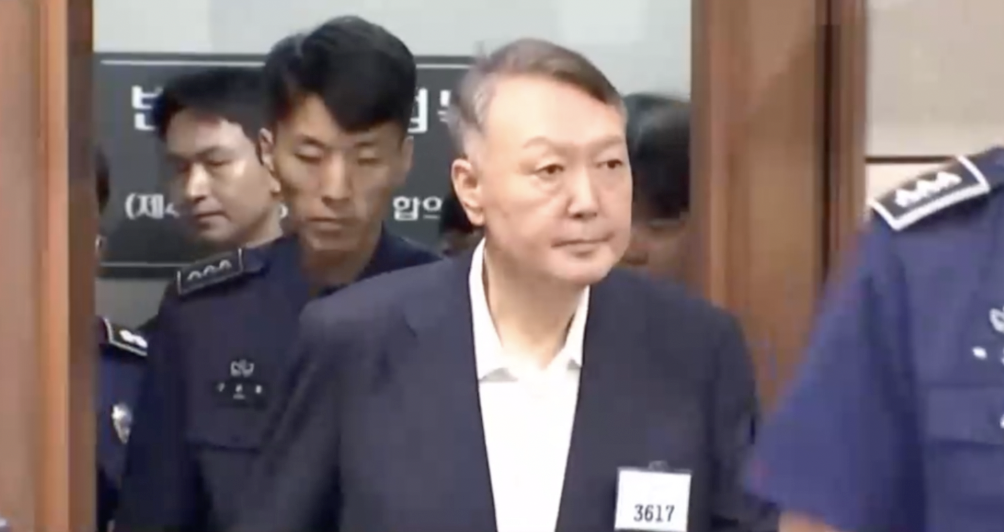
The final hearing in former South Korean President Yoon Suk Yeol’s trial just wrapped up after a marathon 12-hour session in Seoul.
If convicted, Yoon could face a life sentence or even the death penalty, though South Korea has not carried out an execution in decades.
Prosecutors argue that Yoon was behind a plan to suspend parliament and impose martial law in late 2024.
Yoon denies the charges, saying that he acted within his presidential authority, enacting martial law to break a legislative deadlock that he says was harming national security to the benefit of pro-North Korea forces.
Yoon also said the political opposition, which dominates the national assembly, was “paralyzing the judiciary by intimidating judges and impeaching a large number of prosecutors” and causing dysfunction in other government sectors as well.
He had accused lawmakers of “anti-state acts aimed at instigating rebellion,” citing budget cuts that have affected gas projects, military officers, and government payments like childcare support.
He also highlighted national security threats that were unaddressed, giving the example of Chinese nationals who were recently caught with years’ worth of photos from Korean military installations on their devices.
Yoon pointed to allegations of voter fraud. He alleged that the National Election Commission refused to “verify and confirm whether the announced number of votes matches the actual number of voters,” after a court found vulnerabilities in their servers.
Supporters of Yoon rallied outside the courthouse, calling the trial rushed and politically motivated.
“I think this is a time when we must show our support for President Yoon Suk Yeol and raise our voices to say that the insurrection should be found not guilty,” Sung Seo Kyung, a supporter of Yoon said.
Another supporter Cha Kang Seok said, “I believe everything has been rushed since the impeachment trial. I am watching with a prayerful heart, but to be honest, I don’t have high expectations.”
The court is expected to rule on Yoon’s case next month.
President Lee Jae Myung’s Pro-Beijing Stance
While former president Yoon has tried to steer his country closer to the U.S., Lee is leading his party to a more friendly stance toward the CCP.
Lee’s been working to crack down on what he calls hate speech and disinformation. His administration shut down anti-Chinese Communist Party (CCP) protests last year.
These protests erupted after Lee was elected, with concern of him taking a softer stance against the CCP than the former president.
NTD spoke with Gordan Chang, a distinguished Senior Fellow at Gatestone Institute.
“What Lee was referring to is essentially speech against China. People on the streets say CCP out, and they consider that to be hate speech.”
“Now, you can say the worst things about the United States on the streets of Korea, and they won’t let you, you know, they’ll let you go,” Chang said, “So demonstrations against the United States are permitted.
“Demonstrations against China are not,” Chang added.
Lee won the snap election in June 2025 following the motion to impeach Yoon on Dec. 4, 2024, submitted jointly by Lee’s party, the Democratic Party of Korea (DPK), and five opposition parties–Rebuilding Korea Party, New Reform Party, Progressive Party, Basic Income Party, and Social Democratic Party.
Prior to his election as president, Lee faced trials in five courts on 12 charges but all trials have been suspended, according to South Korean media The Chosun Daily.
During a presidential campaign rally in March 2025, Lee criticised Yoon’s approach on China and his comments on the CCP’s military encroachment on Taiwan.
“Why are you provoking China?” Lee said. “What does the Taiwan issue have to do with South Korea?”
In November 2024, a Seoul court had sentenced Lee to one year in prison, suspended for two years, after finding him guilty of lying during his presidential campaign, according to The Korea Times.
It also reported that if the sentence was upheld by the Supreme Court, Lee would lose his parliamentary seat and be barred from running in the 2027 presidential election.
CCP’s Infiltration of South Korea
South Korea is heavily reliant on China for trade and investment, a relationship that has further allowed the CCP to influence its other sectors, including politics.
“Economy, culture, universities, there is no place that hasn’t been penetrated,” a former counter-espionage official, who asked to remain anonymous, previously told The Epoch Times.
Cities in South Korea and China have signed nearly 700 friendship or sisterhood agreements.
Hundreds of Chinese civil servants were sent to work and train in South Korea through a state-sponsored civil servant exchange program. The Chinese embassy pays for South Korean youths to spend a week in China; it hands them books of Chinese leader Xi Jinping’s speeches to read before they depart and expresses hope that they’ll be leaders of future bilateral relations.
A mayor for the South Korean city of Gwangju in 2023 tried to build a park to honor the composer of the anthem of the People’s Liberation Army and a marching song for North Korea in order to attract tourists from China.

The subversion by the CCP in Korea is not as well known compared to the threats from North Korea, but “it is extensive, and it is rather deep,” Tara O, author of The Collapse of North Korea, previously told Epoch Times. She said the effort to build the park was “very ironic.”
“That is just one of cultural warfare by China,” she said.
Dozens of South Korean media outlets carry articles by the CCP’s propaganda mouthpiece People’s Daily.
South Korea also has the highest number of Confucius Institutes, a Chinese state-funded language education program to promote Beijing’s agenda.
In a previous interview with The Epoch Times, Choi Soo Yong, a retired case officer from the National Intelligence Service, noted that there is a room dedicated to the collections of works about Xi at the Seoul National University.
By contrast, the university has no memorial to South Korea’s forefathers.