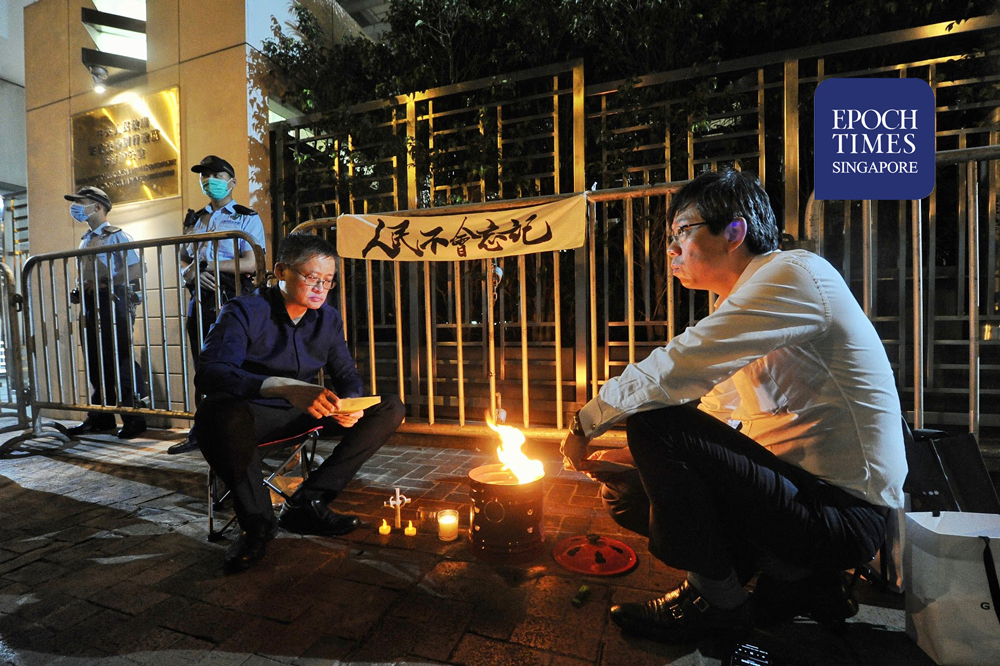
“Xiao Qiang, you Hong Kong people have done enough for us. You must go back alive and tell the world all about this.”
On 4th June 1989, lawyer Kenneth Lam witnessed the mass shootings at Tiananmen Square and the massacre of pro-democracy protestors. Back then, he could barely escape, if not for his Beijing classmates who shielded him from the troops. Today, 31 years later, he would still weep when he recounts the scenes of that fateful night.
This year marks the 31st anniversary of the “June 4 massacre”, the world’s largest commemorative event for the Tiananmen Square protest.
The Hong Kong police, however, had banned the Hong Kong Alliance from holding this annual candlelight vigil at Victoria Park, citing the need to curb the spread of the CCP virus (Covid-19). The Hong Kong Alliance decried political suppression and questioned the new national security law.
While 180,000 mourners joined in the vigil on the eve of the anti-extradition bill protests last year, protestors sat in groups of eight this year, in compliance with Hong Kong’s social distancing rule.
Despite these suppressions, citizen Kenneth Lam said he would not miss the event. Last night, (June 3), Lam faced a group of anti-riot policemen as he led the protest with student representative Chen Qinghua. As for June 4, “I will go as long as Victoria Park is not closed,” said Lam.
Witnessing killings by troops at Tiananmen Square
Thirty-one years ago, Lam was chairman of the Federation of Chinese Students Association and a student at the School of Business Administration of the Chinese University of Hong Kong. At 21 years old, he brought donations and supplies to Beijing and was among the first Hongkongers to lend their support to the Chinese.
Lam stayed at Tiananmen Square on the night of June 3 to 5am the following morning. That night, he witnessed the brutal shooting and killing by the People’s Liberation Army. “For the first time, I held a dying person in my arms with blood flowing out non-stop.”
Lam recalled the first armoured vehicle speeding into the square at 11pm. Protestors were furious and attempted in vain to block the vehicle.
Lam recalled: At 2am, a long line of troops marched into the square from the West to the East gate and began firing along the way, igniting sparks on the ground. Near Mao Zedong’s portrait, a bus was driving towards the soldiers to prevent their advance.
Lam said several soldiers walked towards the bus, pulled the driver down and hit him repeatedly with a gun till he fell to the ground. Thirty metres away, some workers furious with what transpired rushed to stop the troop. Gunshots were heard as one worker threw a glass bottle at the soldiers. Chaos ensued and people were pleading for help.
Assisted by seven others, Lam carried a worker who was bleeding from gunshots on the front and back of his body. “It felt like a faucet was turned on,” he vividly recalled. While the wounded worker was eventually carried to the first aid station, Lam noticed his eyes had turned ghastly white and there were no signs of life in him. “That was the first time I saw soldiers killing students and workers in plain sight. I was startled.”
Shielding Hong Kong students from gunfire

At 4am, soldiers armed with submachine guns were charging towards the People’s Monument. Lam was sitting a few metres away, on the top floor of the monument. “If they had fired the shots, I would have died,” he said. Instinctively, some Beijing students sprang up, shielded Lam with their bodies and pushed him away to safety.
Lam’s eyes welled up in tears as he recalled the scene. “They called my name and said ‘Xiao Qiang, you Hong Kong people are here for us, you have done enough, you have to go back alive and tell the world the truth about all these’”.
That very line became Lam’s life’s mission. Since then, he had kept a low profile, changed his name, started a family and established a career in the legal field. Despite his success, Lam never fails to turn up at Tiananmen Square massacre forums, interviews or protests; his photos of the June 4 incident were published by many international media.
Lam said the June 4 commemoration this year felt especially depressing, with the new national security law triggering a gloomier scene of immigration and capital outflow. When the law was passed on May 22, Lam and Chen Qinghua held a banner that read “Betrayal of Righteousness, Shame on the Chinese Communist Party” as they stood in front of some 100 armed policemen. “That day happened to be my birthday, but I was not in the mood to celebrate… I felt very angry and sad,” he said.
Lam said while a generation of Hong Kongers witnessed the Sino-British Joint Declaration – which guaranteed Hong Kong’s rights, freedom and high degree of autonomy under China’s One Country Two System rule – the treaty was conveniently breached to suppress political dissidents.
Lam admitted that though many elderly Hong Kongers who earlier escaped CCP’s persecution in China had told him when he was young that “CCP is untrustworthy and treacherous”, he still harboured hope of the regime fulfilling its promises after the handover in 1997.
But he had least expected the regime to destroy Hong Kong’s sovereignty after only 23 years. “We must condemn the CCP regime for going back on their word and trampling on its One country, Two Systems promise.”
Lam also worried about his safety. “Because as a lawyer, you often have to challenge the government on behalf of the defendant, but I don’t know how it will be like in the future. While the Hong Kong government is not a part of the central government, it still answers to the central government. Can we still challenge it? Will it be seen as a subversion of power? Or for example, in the future, can we even ask Carrie Lam to step down?”
Lam said he would insist on going out on June 4 for the Tiananmen Square crackdown anniversary. “From this 31st year, we may no longer see such candlelight vigils in Hong Kong. This will also be witnessed by the rest of the world. In fact, with CCP’s surveillance, we have entered another era. Hong Kong will never be the same without the voices of dissidents and conscience. I think this is very sad.”
Hong Kong in the same situation as the Tiananmen Square Massacre
Lam drew close similarities in the Tiananmen Square crackdown in 1989 and Hong Kong’s anti-extradition bill protests in 2019 – where he saw both the glory and ugliness of human nature.
He said among the bouts of glory, there were Beijing students who participated in an indefinite hunger strike in 1989. These students were the elites of the Chinese society, who sacrificed their own future and even their lives to make a stand for the future of their country. CCP political cadres and Beijing citizens, old and young, came out to support the students. After martial law was implemented, he also witnessed the Beijing citizens lying on the road, trying to intercept military vehicles from entering the city.
Lam said thirty years later, the young ordinary citizens of Hong Kong are arrested for the same reason, as they sacrifice to protect and defend their future; soldiering on despite knowing that they would encounter police brutality, bodily harm, arrest and prosecution.
“These are actually very similar to the 1989 democracy movement I experienced 31 years ago, that is, the glorious and beautiful side of human nature that has affected the entire international community and made everyone pay so much attention to Hong Kong. In fact, it has not disappeared, even though there is a powerful regime that is suppressing us and watching our every move.”
On the ugly side of human nature, Lam said many officials and businessmen tried to cover up the incident claiming that no one died in the protests. “Some even said CCP’s crackdown was necessary and supported the twisted logic of killing as a necessary evil in exchange for years of economic development. There is no conscience in this way of thinking.”
During Hong Kong’s anti-extradition bill protests, many citizens were killed by the police. The violence of the police was clearly captured in front of the camera. “We saw officials and businessmen successively coming out to support the government and police brutality. The same scene appeared after the Tiananmen Square Massacre, we saw government officials, businessmen, and powerful figures supporting the regime for personal gain.”
“I think the CCP’s suppression will only get stronger and the scrutiny will be stricter. In the end, whether we choose to embrace the glorious side of humanity or the ugly side is determined by that just one thought of ours.” But Lam emphasized: “Tyranny will not smash the beautiful and glorious side of humanity and we will still live out this part. I want to draw clear boundaries with those who chose the ugly side of human nature and will not want to have anything to do with them.”