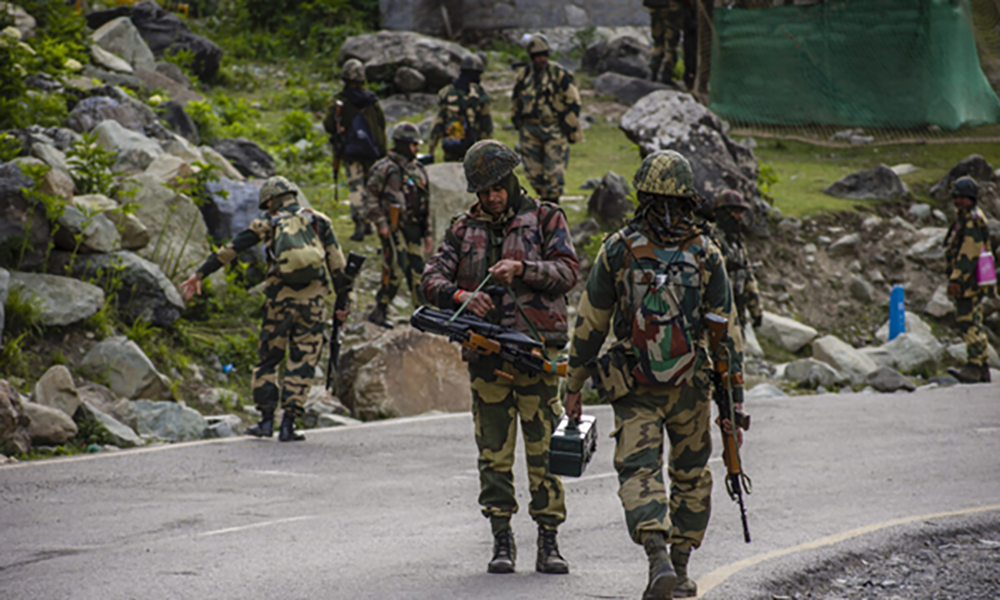
Tensions between China and India have intensified with the deadliest border clash in 45 years in Galwan Valley on June 15.
Citing an unnamed source from U.S. intelligence, U.S. News & World Report said the skirmish is not a result of a tense situation spiraling out of control, but a pre-planned attack by Beijing to intimidate India.
An Indian senior officer and his two non-commissioned officers had reportedly arrived unarmed at a scheduled delegation meeting with the CCP on June 15, to discuss a mutual withdrawal from the region.
The three officers, however, were ambushed and attacked, en route, by dozens of CCP soldiers armed with sticks and spiked clubs. With India calling for reinforcement that same night, the fight escalated into a melee.
India has confirmed 20 Indian troops dead and 76 people injured, while China did not disclose its casualty number. According to the Indian government, the number of Chinese casualties are “similar” to that of India, with all officers and deputies dead.
China and India reached an agreement in 1996 to cease firearms at the border to prevent bloodshed.
In a tweet, former Indian Army officer Ajai Shukla accused Chinese soldiers of “barbarism” and of violating the protocol for using iron rods studded with nails in the latest clash. The tweet went viral and sparked outrage in India.
The nail-studded rods — captured by Indian soldiers from the Galwan Valley encounter site — with which Chinese soldiers attacked an Indian Army patrol and killed 20 Indian soldiers.
Such barbarism must be condemned. This is thuggery, not soldiering pic.twitter.com/nFcNpyPHCQ
— Ajai Shukla (@ajaishukla) June 18, 2020
Tensions between the two nations have spilled over to other areas. As anger towards China escalated, nearly 60 Chinese mobile apps including TikTok and Wechat are now banned in India.
The ban was a blow to Chinese tech companies, including Bytedance which owns TikTok. According to mobile app market intelligence firm Sensor Tower, TikTok amassed 2 billion downloads globally by Q1 2020, with a third of the downloads coming from India.
Beijing’s strong arm tactic against India may have achieved just the opposite.
China’s Strategic Blunder
Though border issues dominate the headlines, the strain in China-India ties has its root in one big strategic mistake of Beijing — the Belt and Road Initiative (BRI).
The BRI involves massive loan projects that fund land and maritime infrastructure, expanding Beijing’s influence westward across central Asia, the Middle East, further extending to Europe and down to Eastern Africa.
While it appears to accelerate economic development across regions, the project is quietly changing the geopolitical landscape.
Beijing’s true intention is to gain influence in regions where US influence is relatively weak, according to China analyst, Wen Zhao, who owns one of the most watched Chinese language political talk shows on Youtube.
“Today, on both sides of the Atlantic, on both sides of the Pacific, the pro-democracy camp is dominant,” said Wen Zhao.
“On both sides of the Atlantic you have the United States and Europe. On the east of the Pacific, there’s the United States, and on the west there are Japan, South Korea, and Taiwan, where the pro-democracy camp is also dominant.”
“The CCP therefore could only put its hope in regions with relatively weak military and diplomatic influence from Europe and the US, including Central Asia, West Asia, and the Indian Ocean. This is how the Belt and Road Initiative is designed.”
The strategy looks almost perfect, except that it overlooked the region’s superpowers – India and Russia – as Beijing buys its influence westward.
Debt-ridden with heavy investment loans from Beijing, Sri Lanka was forced to lease its deep-sea port of Hambantota to China for 99 years, starting from 2017.
That same year, the Pakistan government also leased Gwadar port to China for 40 years. The port would reportedly be developed into a Chinese naval base, although Beijing has denied the claim.

Located between Pakistan and Sri Lanka, India could potentially face military threats from China’s two new sea ports.
“It is for this reason that Sino-Indian relations have deteriorated sharply since 2015,” said Wen Zhao.
In addition, Beijing’s heavy investment in Central Asian countries, including Kazakhstan, Kyrgyzstan, Tajikistan and Uzbekistan, may impinge upon Russia’s interests in the region.
“[The BRI] is a deeply flawed strategy that costs China billions, and leads to deterioration in its relationship with the US, Russia and India,” said Wen Zhao.